Vermont geology
BY Georgia Lambrakis
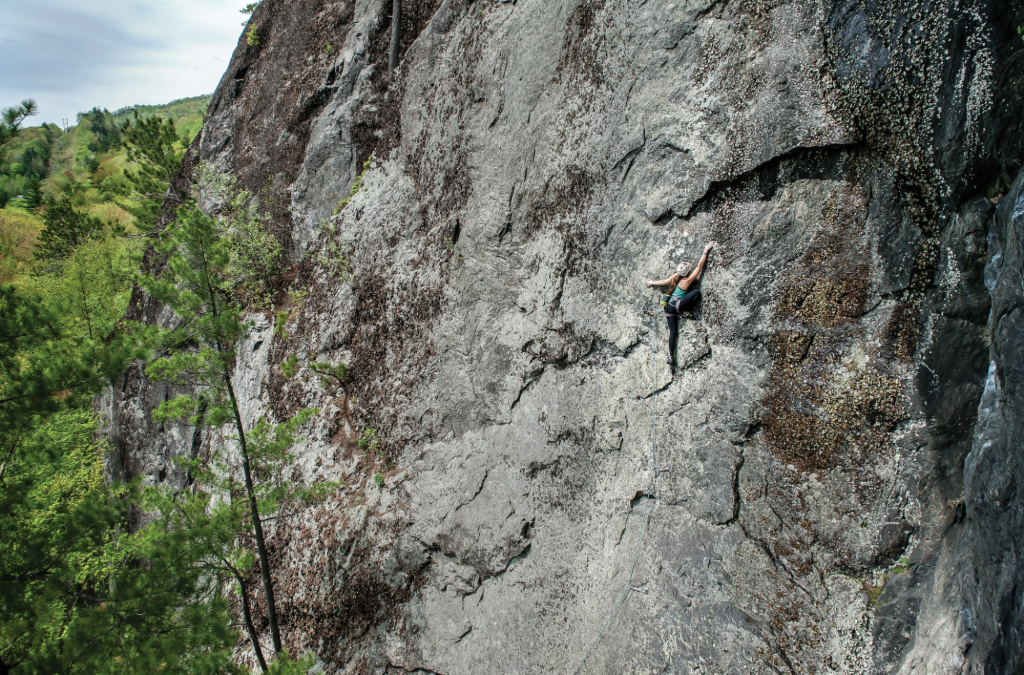
Twenty miles east of Burlington, tucked behind a trailer park and overlooking I-89, a 300-foot wall of shiny, flaky, silvery-green rock bulges from the hillside. Climbers have dubbed this local crag the Bolton Dome. For decades, the Dome sat dormant and closed to the public until CRAG-VT purchased the property in 2017 with help from the Access Fund and local community members.
The rock that makes up this marvel and much of the Bolton area is green schist, a metamorphic rock that is introduced on Mountain Project as “running the gamut from extremely sound to fairly chossy,” noting that “our schist is very difficult to read, which takes getting used to.” But the rock is not this way by accident; it is a quality shaped by history and a story written in the rock itself.
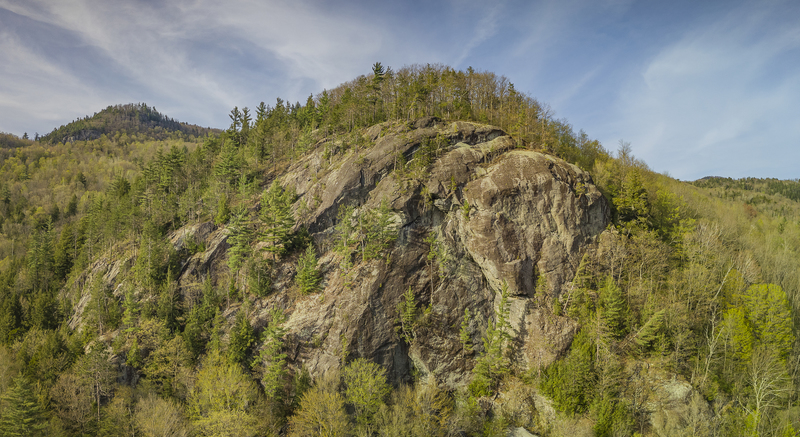
Every flake and handhold on the Dome is the end result of a geologic pileup with a backstory spanning 450 million years. On an average day at the crag, it’s unlikely you’re thinking about an ancient seafloor cooked, compressed, and transformed by continental collision, then slowly uncovered by erosion, and sculpted by a mile of ice. But to understand the Dome and its geologic history is to understand how Vermont itself was formed, and how every climber is intrinsically connected to geologic processes that unfolded on a truly massive, almost unimaginable timescale. Understanding the geologic history of Schist adds a whole new layer to one of Vermont’s most beloved crags, where hundreds of climbers return each season to explore 80 routes of all grades, styles, and technical challenges.
Choss! If you’ve ever been climbing in Vermont you’ve likely heard someone say something about our rock being chossy. Choss is an umbrella term for poor rock quality while climbing, and usually means loose and unstable rock. The crumbly, shiny, layered character of the rock around Bolton isn’t a quirk of one cliff in Vermont it’s actually the signature of an entire rock type. To understand why the rock in Bolton behaves the way it does, you have to start with schist itself. So what is schist and how is it created?
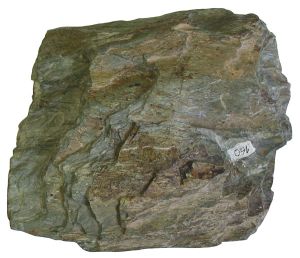
Schist doesn’t start out as schist. It’s a rock with a rich past life, that began at the bottom of the seafloor, when mudstone or shale was subjected to intensely high pressures and temperatures (more on that later). That transformation falls under a broader category of rock change called metamorphism, and understanding it is key to understanding every ledge and crack at the Dome.
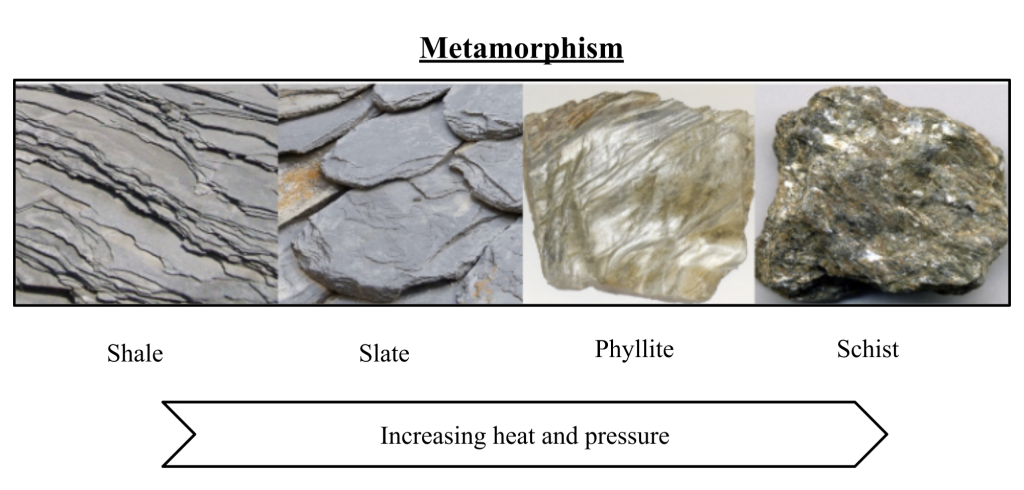
Metomorphism, the solid-state transformation of rock at intense temperatures, causes foliation, the planar arrangement of structural or textural features. To explain this phenomenon, we can look at an example pulled from an old geology textbook. Imagine a stack of printer paper, 500 sheets, all lying flat. If you were to drop a heavy book on top of it and then try to rip through the stack from the side, cutting across all the sheets, it would be very difficult, likely requiring scissors or the force of a saw. But if you were to slide your finger between two sheets, they would split apart instantly with little effort. That’s foliation.
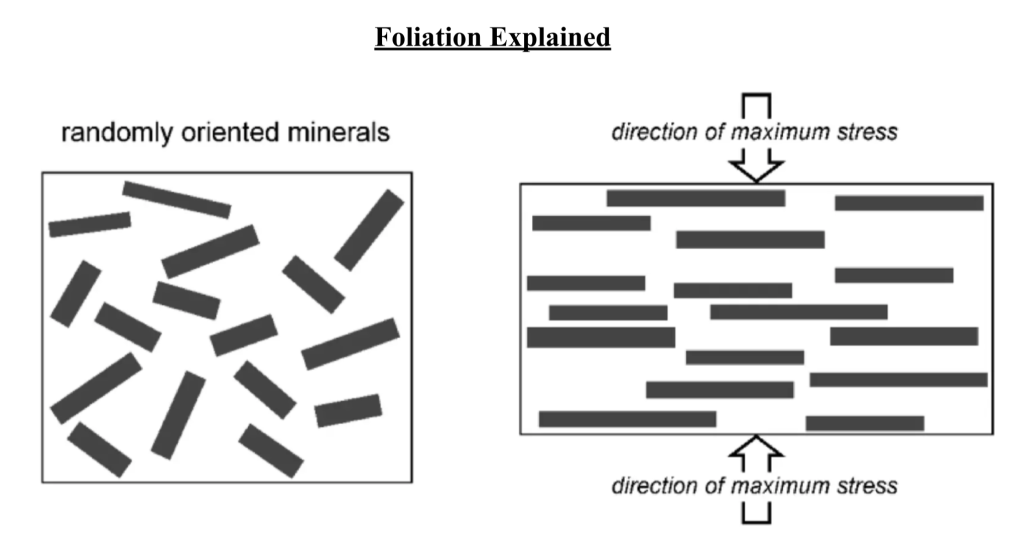
The rock develops a “grain,” and like wood it splits easily along that grain but resists breaking across it. Mica minerals, which are found abundantly in the Dome’s schist, are naturally shaped like tiny flat sheets, almost like microscopic flakes of glitter. When mudstone is buried deep and squeezed by tectonic pressure and heat, those mica flakes can’t stay randomly jumbled. They rotate until they lie flat, perpendicular to the direction of the squeeze. Once millions of these tiny sheets are stacked parallel to each other, the schist will split easily along those planes. In geologic terms, this phenomenon is called schistosity.
With that in mind, we can return to the “chossy” nature of the Bolton rocks. When a climber pulls on a hold, they’re pulling on rocks with 450-million-year-old planes of weakness running through them. If the foliation runs the wrong way relative to the hold, a flake can pop off in your hand or crumble easily…which is never fun, but a little cooler when you understand the science behind the fracture.
There are multiple varieties of schist, each named for its dominant mineral composition. At the Dome, the schist is rich in a mineral called chlorite, which has a green to blackish appearance. This gives the rock its name, green schist, a type commonly found throughout Vermont’s Green Mountain Belt. Green schist doesn’t just appear on its own though. Something has to bury a rock deep enough and squeeze it hard enough to rearrange its mica minerals. In Vermont’s case, that “something” was a continental collision, the Taconic Orogeny, and it’s the reason the Bolton Dome exists like we know it today.
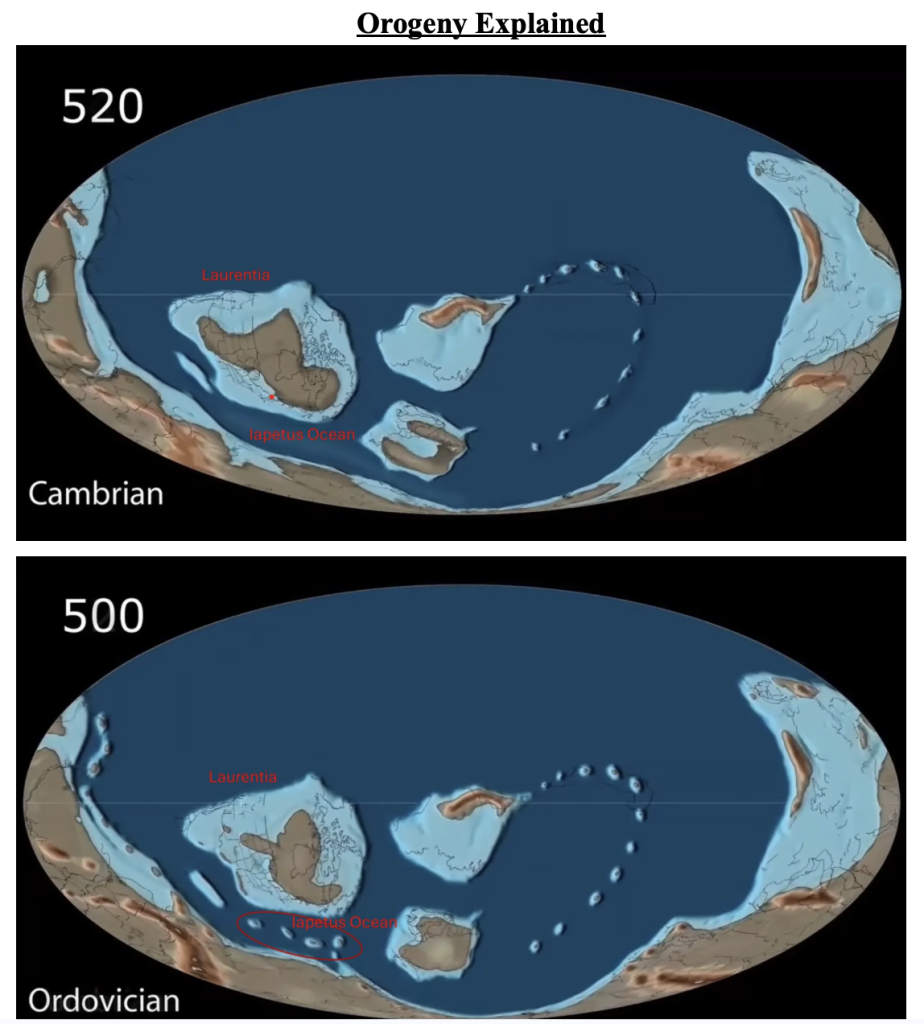
Mountain building events occur when tectonic plates collide which can cause Earth’s crust to uplift, creating mountains. This event, known as an orogeny, happens over million year timescales and prominent mountain ranges like the Himalayas are still rising yearly due to active plate collision. About 520 million years ago, during the Cambrian period, Vermont sat at the bottom of what’s known as the Iapetus Ocean, a tropical sea that once stretched across the equator. The red dot shown in the map is where Vermont resided fully underwater. Circled in red we can see a volcanic island arc begin to form 20 million years later during the Ordovician Period. The island arc was then pressed into Laurentia (ancient North America) uplifting the rocks buried deep in the crust. As the tectonic plates of Laurentia and the Iapetus Ocean converged, the mud was metamorphosed, transformed from sediment into rock, and ultimately into much of the schist we see today. This event led to the formation of the Green Mountains and gave rise to rock formations we climb on today, including the Bolton Dome. While the Taconic Orogeny was the inciting incident that built the mountains and formed the rock, the Bolton Dome sat buried under thick layers of sediment for millions of years. To expose the Dome, Vermont needed a second massive event: the Ice Age.
Over 25,000 years ago the Laurentide Ice Sheet buried Vermont under one to two miles of thick ice, overtopping even its highest peak, Mount Mansfield. As the climate warmed, the ice began to melt and retreat, gradually exposing the landscape we recognize today. During this retreat, the schist underwent significant physical modification through erosion and the immense pressure of overlying ice and sediment. While the internal rock structure remained the same, the surface of the schist was dramatically reshaped.
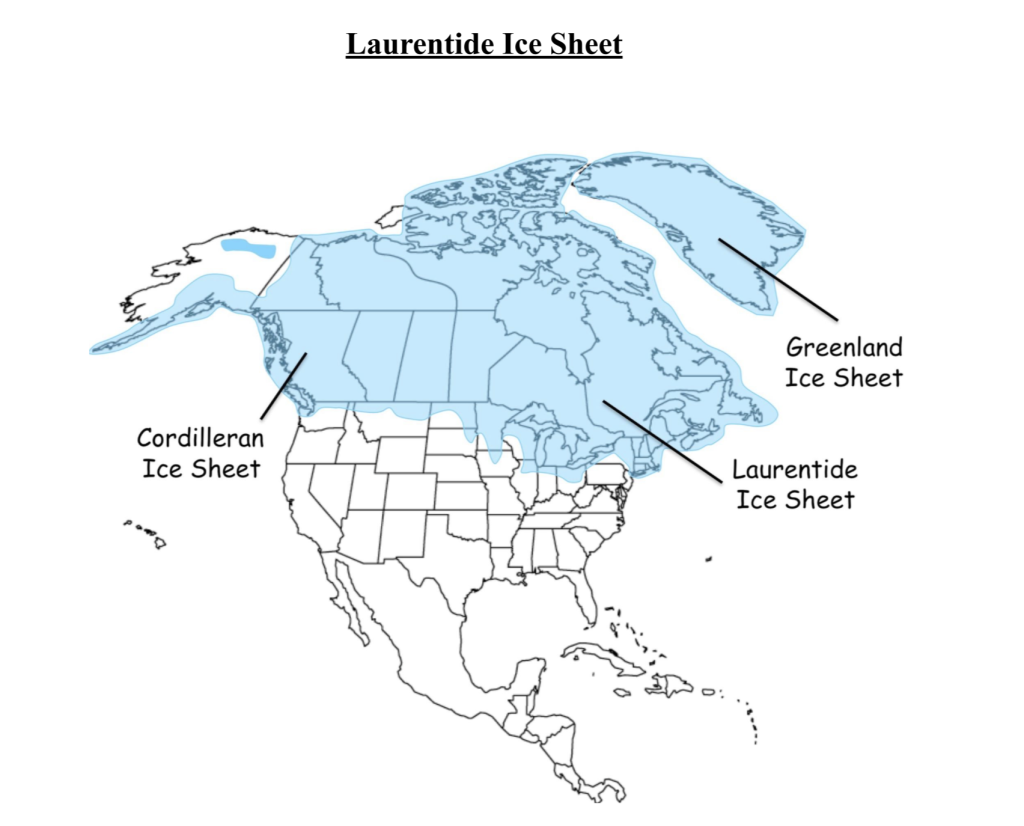
As the ice sheet moved, it smoothed and abraded the rock, the glacial ice acting like sandpaper as it dragged embedded boulders across the schist. The glaciers also plucked large blocks of rock from these formations, transporting them miles from their original locations. These displaced rocks are known as glacial erratics, and they often differ from the surrounding local geology, making them easier to identify. The largest glacial erratic in Vermont is the Green Mountain Giant in Whitingham, which weighs approximately 3,400 tons. Finally, the combined forces of moving ice and rushing meltwater carved the Bolton Dome itself, creating its cliff edges, caves, overhangs, crimps, and natural pockets.
Rocks are very easy to take for granted. They line our hiking trails, they pave our streambeds, they’re the thing you’re cursing as you take another fall on your project. But the Bolton Dome is a reminder that every cliff and crimp has a backstory, and Vermont’s happens to be a wild one. An ocean that is no longer, a mountain range cooked and compressed, an ice sheet that came and went, all working together over half a billion years to leave behind a 300-foot wall of green schist tucked behind I-89. Our community and CRAG-VT fought for years to get access back to this incredible cliff. It’s worth remembering that the rock itself spent a lot longer than that getting here. The Dome is ours to climb on now, for a while, anyway, but one day millions of years from now our region will once again be altered and shaped by varying degrees of deformation, transitions and likely…climate change. The least we can do is pay attention, make peace with choss, and appreciate the beauty in the geological wonder that is the Bolton Dome.